Showing posts with label comics. Show all posts
Showing posts with label comics. Show all posts
Friday, June 4, 2010

Friday, April 30, 2010
comics o' th' decade. episode: li'l pico de gallo
Ever wonder how adolescence could have been more awkward an alienating? How about if you grew a mouth in your chest or a tail? Or what if your skin molted?
 Black Hole (Charles Burns)
As unsettling as your own experience with puberty may have been, your dark teenage heart could only hope to match the blackness depicted in this series. Burns makes the worst fears of high school real, replacing acne with truly grotesque deformation, estrangement with actual banishment. Sex and the deepest anxieties about its dangers—desease, social rejection—are everywhere in this book. Yonic imagery is inescapable.

All this unease is illustrated magnificently by Burns's deep and foreboding blacks. This book is creepy for sure, but it also cuts into the innermost circle of our neuroses and shows how universal they are. And there's comfort in knowing you weren't or aren't alone.
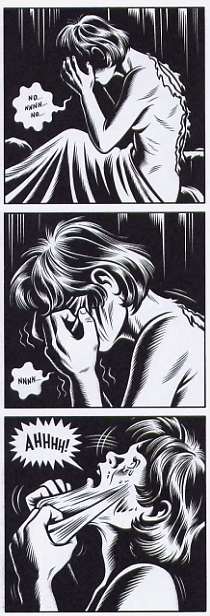
As unsettling as your own experience with puberty may have been, your dark teenage heart could only hope to match the blackness depicted in this series. Burns makes the worst fears of high school real, replacing acne with truly grotesque deformation, estrangement with actual banishment. Sex and the deepest anxieties about its dangers—desease, social rejection—are everywhere in this book. Yonic imagery is inescapable.

All this unease is illustrated magnificently by Burns's deep and foreboding blacks. This book is creepy for sure, but it also cuts into the innermost circle of our neuroses and shows how universal they are. And there's comfort in knowing you weren't or aren't alone.
Thursday, April 29, 2010
comics of la décade: episode li'l biblioteca
Kabuki (David Mack)
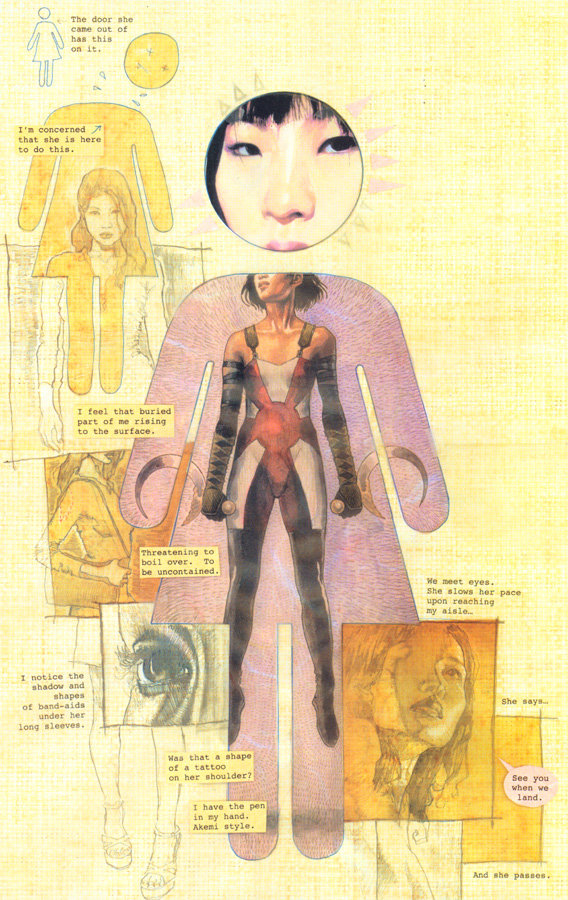
I bought my first issue of Kabuki (Metamorphosis #5) sometime during my senior year of high school. It was completely novel and I was enthralled even though I really had no idea what the hell was going on. I must of stared at those pages for hours trying to decipher the action. Some character named Kabuki was trying to escape from orderlies, preppy ninjas, and some kind of order of secret agents. These weren't your standard muscle-bound, spandex-wearing, Kirbyesque fisticuffs.

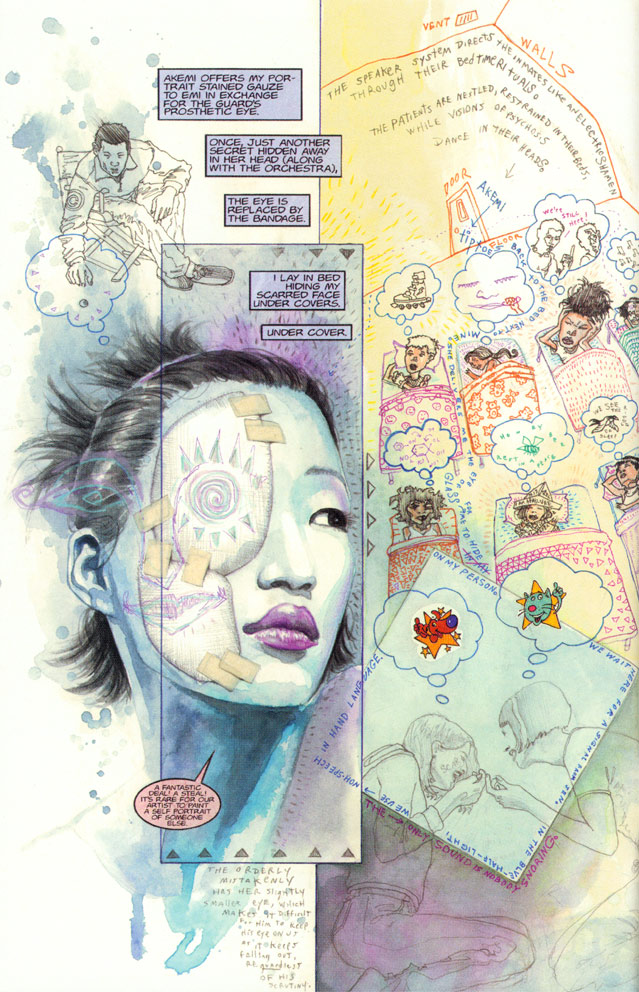
Kabuki wades through various genres—spy, superhero, cyberpunk, sci-fi, martial arts—using them as tools to expand on larger themes of identity and family, and the relationship between action and thought. Mack illustrates abstract ideas by placing his characters in abstract scenery—trapped in a blank limbo, floating in textures of water color and acrylic paint, running in Escher-esque algorithmic landscapes.

And just as he melds genres, Mack incorporates a wide variety of art media—pen and ink, watercolor, collage, pencil, oil, acrylic, photography, and sculpture. He uses a different medium and different styles within mediums depending on what's happening within the narrative. Action sequences may take on a more traditional comic book feel; while scenes focusing on the character's past and familial relationships might take on a looser, splotchy water color feel; and philosophical discussions between characters might take on a child-like expressive feel.

My point, really, regardless of all the highfalutin' bluster above, is that Kabuki is one of the most beautiful works of art I've ever seen. And the story is hugely ambitious, entertaining, and thought-provoking.
I bought my first issue of Kabuki (Metamorphosis #5) sometime during my senior year of high school. It was completely novel and I was enthralled even though I really had no idea what the hell was going on. I must of stared at those pages for hours trying to decipher the action. Some character named Kabuki was trying to escape from orderlies, preppy ninjas, and some kind of order of secret agents. These weren't your standard muscle-bound, spandex-wearing, Kirbyesque fisticuffs.

Kabuki wades through various genres—spy, superhero, cyberpunk, sci-fi, martial arts—using them as tools to expand on larger themes of identity and family, and the relationship between action and thought. Mack illustrates abstract ideas by placing his characters in abstract scenery—trapped in a blank limbo, floating in textures of water color and acrylic paint, running in Escher-esque algorithmic landscapes.

And just as he melds genres, Mack incorporates a wide variety of art media—pen and ink, watercolor, collage, pencil, oil, acrylic, photography, and sculpture. He uses a different medium and different styles within mediums depending on what's happening within the narrative. Action sequences may take on a more traditional comic book feel; while scenes focusing on the character's past and familial relationships might take on a looser, splotchy water color feel; and philosophical discussions between characters might take on a child-like expressive feel.

My point, really, regardless of all the highfalutin' bluster above, is that Kabuki is one of the most beautiful works of art I've ever seen. And the story is hugely ambitious, entertaining, and thought-provoking.
Tuesday, March 23, 2010
comix o'the decade: Episode Li'l Noodle

Promethea
Alan Moore—writer
J.H. Williams III—pencils
Mick Gray—inks
Jeromy Cox—colors
(ABC/Wildstorm/DC Comics)
Blah blah blah Alan Moore. Blah blah blah genius. Hurdy gurdy machine.
Looking for pulp fantasy action and adventure? It's here. Looking for a dissertation about the nature of reality and fiction, where they intersect with our minds, bodies, and spirits? Look no further. Moore has cleverly wrapped up a philosophical discussion of the origins of storytelling and its purpose in the guise of a sci-fi fantasy. It can be a difficult read. There are a lot of big, abstract ideas that Moore bats around. Some of the dialogue can be stilted and dry. But at the same time, the ideas it's floating are fascinating. In the world of Promethea everything has metaphorical meaning—whether literary or sexual or mythical or religious, which for all intents and purposes, in this comic, are the same. Moore has worked up a unified theory of everything that's not based on science, but on history, humanity, and mysticism.
It's one of a few comics that encourages you to really think about the world around you, your relationship to the work in your hands—it can make you think about every story ever spun in a new light.

What helps steer it clear of dreary philosophic pedagogy and make it truly palatable and amazing is the art. The team of J.H. Williams, Mick Gray, and Jeromy Cox (with appearances by Jose Villarrubia and Charles Vess among others) construct the most innovative and imaginative page layouts printed by a major comics publisher. Each page visually underscores the themes in the script, whether its using historical or cultural motifs (see above) or clever circuitous action (see infinity layout at top). Moore is notorious for writing obsessively detailed scripts with very specific page layouts, so a fair amount of credit is due to him. However, it'd be tough to find other comics artists who would be able to translate that vision to the page with as much diverse technique, daring, and verve as this team of artists. Plus it's fun to navigate and pretty to look at.

There are just a ton of moments like this one that make my mouth drop. The artwork beautiful, yes, but it's also completely insane. It kind of explodes everywhere. Speech bubbles become like little fireworks, The color palate makes it borderline illegible, but this one page is part of a larger interconnected whole.
There's more here than one would expect.
Thursday, March 18, 2010
Comics o'the Decade: Episode Li'l Playa
Bone (Jeff Smith, Cartoon Books)
If there's one comic that's almost universally guaranteed to please, this is it. Three bone creatures (from Boneville, of course!) accidentally stumble upon a valley with talking woodland animals, cow races, and that gitchy feelin'. I don't want to give away any major plot points, so in trying to avoid that, I'll just say it's equal parts Pixar and Tolkien (or what I imagine Tolkien is like... I've never actually read the ring trilogy)—incredibly accessible, thoroughly engrossing, with a great balance of adventure, mystery, and humor.

Of course, the art is ridiculous (none of my picks of this decade's best have less than stellar art). Jeff Smith is a master of comics storytelling. He manages to pick out the right angles, expressions and poses at the right times for the maximal dramatic and comedic effect. And what's especially noticeable in the uncolored version is his beautiful brushwork and how well he spots his blacks. His ability to set the mood and give his figures weight based on how he varies his line thickness and places shadow is remarkable.

Jeff Smith kicked off Bone roughly 20 years ago. But the series was completed only in 2004. It's been collected in one massive phone-book-sized tome in its original, beautiful black and white. Scholastic has reprinted the series in smaller volumes and in tasteful color.

If there's one comic that's almost universally guaranteed to please, this is it. Three bone creatures (from Boneville, of course!) accidentally stumble upon a valley with talking woodland animals, cow races, and that gitchy feelin'. I don't want to give away any major plot points, so in trying to avoid that, I'll just say it's equal parts Pixar and Tolkien (or what I imagine Tolkien is like... I've never actually read the ring trilogy)—incredibly accessible, thoroughly engrossing, with a great balance of adventure, mystery, and humor.

Of course, the art is ridiculous (none of my picks of this decade's best have less than stellar art). Jeff Smith is a master of comics storytelling. He manages to pick out the right angles, expressions and poses at the right times for the maximal dramatic and comedic effect. And what's especially noticeable in the uncolored version is his beautiful brushwork and how well he spots his blacks. His ability to set the mood and give his figures weight based on how he varies his line thickness and places shadow is remarkable.

Jeff Smith kicked off Bone roughly 20 years ago. But the series was completed only in 2004. It's been collected in one massive phone-book-sized tome in its original, beautiful black and white. Scholastic has reprinted the series in smaller volumes and in tasteful color.

Friday, March 5, 2010
CoD: Episode Li'l Taco
Another Comic of the Decade:
Strangers in Paradise (Terry Moore, Abstract Studios)
SiP is the best melodrama comic book ever. Nothing else even comes close. It's the story of how Francine, Katchoo, and David redefine themselves after escaping separate pasts that none of them are proud of. We follow them through a tangle of romantic successes and failures, a good bit of multinational corporate conspiracy, and bit of time travel even (i.e., non-linear storytelling... not, like, an actual time machine). It's all here—love and heartbreak, fisticuffs, prostitution, gunplay, Hawai'ian beaches, laughter and tears.
Anyway, I already wrote about it. So I won't bore you with more jibberjabber. There are 6 pocketbook collections. You might even be able to find them at your local library. Go read it. You won't be disappointed.

Strangers in Paradise (Terry Moore, Abstract Studios)
SiP is the best melodrama comic book ever. Nothing else even comes close. It's the story of how Francine, Katchoo, and David redefine themselves after escaping separate pasts that none of them are proud of. We follow them through a tangle of romantic successes and failures, a good bit of multinational corporate conspiracy, and bit of time travel even (i.e., non-linear storytelling... not, like, an actual time machine). It's all here—love and heartbreak, fisticuffs, prostitution, gunplay, Hawai'ian beaches, laughter and tears.
Anyway, I already wrote about it. So I won't bore you with more jibberjabber. There are 6 pocketbook collections. You might even be able to find them at your local library. Go read it. You won't be disappointed.

Monday, March 1, 2010
comics of the decade, episode li'l uno
Not much in the way of comics news from these parts in the last while. I still read 'em, I just don't read 'em like the coke-bottle-spectacled, cape-wearing, adolescent nerd-bot that I was in my salad days. My tastes have rolled a little to the left since my awkward years and I read fewer fist-fights-in-tights pamphlets and more long-form narratives that are less about power fantasies and more about humanity.
I'm not in the shop every Wednesday, so I imagine I'm missing out on a good bit of reading material. That said, I'm fairly confident that I read, or at least sampled, most of the of the major mainstream comics publications of the past decade; and when I say mainstream, I mean comics embraced by book stores and book reviewers at places like the New York Times, and not what the comics industry considers mainstream, which is Amazonian Princesses through General Zod, not that there's anything inherently wrong with either, I'm just noting that there's a discrepancy between mainstream's mainstream and comics' mainstream.
Also, if anyone has suggestions regarding the best comics since 2000/2001, shout 'em out. I'm curious as to what y'all have been reading comics-wise, and if you've been reading comics at all. I'm sure my list is devoid of a few titles that I either forgot I read or completely missed.
It maybe is a little late for a Comics of the Decade! post, but comics are slow to make... and so is this list.
Notes regarding my picks:
- This is in no particular order of preference.
- The list is completely subjective, there were no specific criteria I was looking to fill other than my personal enjoyment and fulfillment in reading the book.
- Some of these comics were originally published in pamphlet form back in the nineties, but weren't collected into TPBs until the aughts and so therefore were available to people who wouldn't go into a comic shop until this past decade, hence they're eligible for consideration.
First, but not necessarily best or worse...
... well, let's get the obvious one out of the way:
Jimmy Corrigan, the Smartest Kid on Earth (Chris Ware; Pantheon)

OK. So here's the thing with this book: even though it can kind of drag narrative-wise, and the main character is pathetic and unappealing in every way imaginable, it is still MINDBLOWING. There's a reason Chris Ware's art has been gallivanting around the country in various exhibitions at fancy art establishments. It's a maze of delights. The line-art is sparse, obsessively clean and precise, yes, but the page layouts and panel arrangements are dense with information and require a very active reader to fill in all the action between the static images and make connections between non-linear scenes.
The storytelling is what I would call decompressed—there are a lot of small moments depicted, tiny gestures like furrowed brows and scratched noses. These are often unnecessary for the plot, but they have a huge impact on the mood of the story. The events of the page above could have been summed up in two or three panels—woman sits and daydreams; woman gets up; woman opens door—but then we would have missed out on the fidgitiness and the mundanity of the waiting room experience, not to mention the puzzle that is the interpersonal relationships of all the characters.
To cut into the somewhat serious nature of the story of this hapless loner stumbling through various disastrous and painful familial relationships is, thankfully, a great deal of humor, which while dust dry and often morbid, still helps keep the pages turning.
The storytelling is what I would call decompressed—there are a lot of small moments depicted, tiny gestures like furrowed brows and scratched noses. These are often unnecessary for the plot, but they have a huge impact on the mood of the story. The events of the page above could have been summed up in two or three panels—woman sits and daydreams; woman gets up; woman opens door—but then we would have missed out on the fidgitiness and the mundanity of the waiting room experience, not to mention the puzzle that is the interpersonal relationships of all the characters.
To cut into the somewhat serious nature of the story of this hapless loner stumbling through various disastrous and painful familial relationships is, thankfully, a great deal of humor, which while dust dry and often morbid, still helps keep the pages turning.

Obviously a lot could be written about this book, and I'm not going into a huge amount of detail (thematically there's a lot going on in this book, both story-wise and art-wise, which I'm sure some overly enthusiastic grad student has or will write their thesis on). Suffice it to say that the art is gorgeous and easy to lose yourself in. And the character of Jimmy Corrigan is hard not to stare at with some sense of awe and horror as you would an albino burn victim. Except the scarring is on the inside.
Sunday, October 18, 2009
asterios polyp
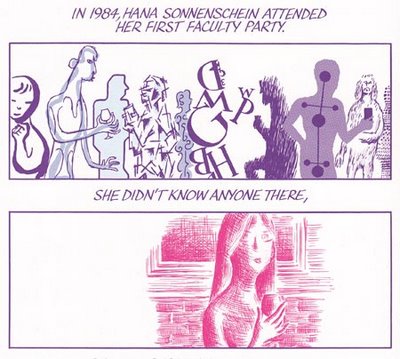
it's received some pretty high praise from most critics. i recommend it. it's 100% solid comics. there are few artists working in comics who tie together the words and images together to underscore the meaning as well as david mazzuchelli does in this book. it's also pretty.
it seems likely to get enveloped into the canon of great american comic books: jimmy corrigan, blankets, black hole, asterios polyp.
Tuesday, March 24, 2009
Monday, March 9, 2009
the inevitable (dweebish) watchmen post
Saw Watchmen yesterday. It was good. About as good as I expected. There were scenes that were incredibly campy, some that were profound. Among other things there was lots of blood; overly prettified fight choreography; a giant, naked blue man; too much CGI; and one sex scene that went on too long and in a kind of ridiculously showy manner. There seems to be somewhat universal agreement that the film adhered too closely to the comic book and failed to create its own identity. The critics loved Jackie Earle Haley's portrayal of Rorschach and hated Malin Ackerman's Silk Spectre. I thought they were both adequate. The major difference being that Rorschach's character—demented, violent, uncompromising—is just way more compelling to watch or read. It was the same in the comic book—its two best chapters are 5 and 6, which focus almost mostly on Rorschach.
My general feeling is that making Watchmen into a movie is about as silly as making Citizen Kane into a comic book. In adapting it, it lost a major component of what makes it such a great piece of work—its comic bookness. As much as it's a story about superheroes trying to save the world, it's also a story about debunking the myth of the comic book hero. And as much as it's a fine piece of pomo, non-linear storytelling, it's also really a twelve part course in how comic book stories are told—the ways to relate one comic book panel to another. And this last part, I believe, is really what made Watchmen "unfilmable" as its been called on so many occasions (probably most often by its cantankerous mastermind). It's unfilmable because one of the intrinsic values of the story is that it is a comic book.
There are certain things that comics allow for that helped develop some of the themes—symmetry and time—of Watchmen and this relationship between panels is one of them. The comic book's page-layout holds almost entirely to a grid divided evenly in 18 sections. Most pages had 9 panels, but whatever the configuration was, it held to that underlying grid. While it lent a certain rhythm and structure to the pages look and narrative pacing (the effects of which, I don't think I entirely understand), it also allowed for a vast use of symmetry in the page designs (see the page depicting Rorschach's capture). In as much as Watchmen was important to comics with respect to its mature subject matter (it being an instigator for the movement of comics' target audience from 8-to-12 year-olds to 18-to-30-somethings), it was equally important regarding how its panels tell the story.
The narrative flashes back and forth in time throughout the story. As Dr. Manhattan says later on in the book, "There is no future. There is no past... Time is simultaneous..." With the comic you can easily move forwards and backwards in the narrative just by turning some pages. By looking at an entire page at once you can see moments in the story happening simultaneously. Rorschach is a character of dichotomies. He sees everything in a prism of good/evil and right/wrong. His life is divided into two periods, when he was Walter Kovacs and when he became Rorschach. His mask is a mercurial Rorschach blotch, perpetually moving to make new symmetries. So the gimmick of using symmetry in the illustrations to underscore his character traits is an obvious enough device.
In the page depicting Rorschach's capture (and a number of other pages in book), the coloring of the panels is symmetrical. But the way in which that device functions in the comic is what makes it work so well. The physical motivation behind the color change in the panels is the flashing neon light in the background (The neon light features a symmetrical skull-and-crossbones in its design). The alternating color in conjunction with the rigidity of the grid-based layout acts as a sort of metronome, ticking off the moments until the issue's climax. And while it functions as a sort of timing device, in order to actually see the symmetry on the page the reader must look at all nine panels at once, such that what's happening in the first panel of the page is synchronous with the last panel. The symmetry is only apparent by making time stop in the story.
This is something that couldn't really be done in film. The comic book ties together these themes of symmetry and synchronicity in a very particular comic book-y way. Certainly the themes portrayed on film, but not in the same manner.
And this is one of the major strikes against the film. Outside of cutting scenes out of chronological order, there's little thematic play in its narrative technique. It cops the style of the comic without paying attention to the substance conveyed by that style. Snyder and co. didn't make much of an effort in that regard. They had an opportunity to create a very striking visual vocabulary (maybe using simultaneous imagery or montage, for instance) and they didn't. The only elements of the film they seemed to take liberties with were the credit sequence and the fight choreography and physics of battle, which were essentially a Matrix rehash with more blood.
A similar argument could be made for the murder mystery aspect of the story. Rorschach and Nite Owl's investigation into the Comedian's death and the reader's efforts to create order out of Moore and Gibbon's disjointed narrative are underscored by comics' innate qualities—the setting of illustrated panels together to create a larger picture. The comic doesn't just resemble a puzzle, it is a puzzle.
The movie, in the end, was the fireworks without the orchestra.
the art (click to enlarge) of Dave Gibbons, John Higgins, and Alan Moore:


more TK?
My general feeling is that making Watchmen into a movie is about as silly as making Citizen Kane into a comic book. In adapting it, it lost a major component of what makes it such a great piece of work—its comic bookness. As much as it's a story about superheroes trying to save the world, it's also a story about debunking the myth of the comic book hero. And as much as it's a fine piece of pomo, non-linear storytelling, it's also really a twelve part course in how comic book stories are told—the ways to relate one comic book panel to another. And this last part, I believe, is really what made Watchmen "unfilmable" as its been called on so many occasions (probably most often by its cantankerous mastermind). It's unfilmable because one of the intrinsic values of the story is that it is a comic book.
There are certain things that comics allow for that helped develop some of the themes—symmetry and time—of Watchmen and this relationship between panels is one of them. The comic book's page-layout holds almost entirely to a grid divided evenly in 18 sections. Most pages had 9 panels, but whatever the configuration was, it held to that underlying grid. While it lent a certain rhythm and structure to the pages look and narrative pacing (the effects of which, I don't think I entirely understand), it also allowed for a vast use of symmetry in the page designs (see the page depicting Rorschach's capture). In as much as Watchmen was important to comics with respect to its mature subject matter (it being an instigator for the movement of comics' target audience from 8-to-12 year-olds to 18-to-30-somethings), it was equally important regarding how its panels tell the story.
The narrative flashes back and forth in time throughout the story. As Dr. Manhattan says later on in the book, "There is no future. There is no past... Time is simultaneous..." With the comic you can easily move forwards and backwards in the narrative just by turning some pages. By looking at an entire page at once you can see moments in the story happening simultaneously. Rorschach is a character of dichotomies. He sees everything in a prism of good/evil and right/wrong. His life is divided into two periods, when he was Walter Kovacs and when he became Rorschach. His mask is a mercurial Rorschach blotch, perpetually moving to make new symmetries. So the gimmick of using symmetry in the illustrations to underscore his character traits is an obvious enough device.
In the page depicting Rorschach's capture (and a number of other pages in book), the coloring of the panels is symmetrical. But the way in which that device functions in the comic is what makes it work so well. The physical motivation behind the color change in the panels is the flashing neon light in the background (The neon light features a symmetrical skull-and-crossbones in its design). The alternating color in conjunction with the rigidity of the grid-based layout acts as a sort of metronome, ticking off the moments until the issue's climax. And while it functions as a sort of timing device, in order to actually see the symmetry on the page the reader must look at all nine panels at once, such that what's happening in the first panel of the page is synchronous with the last panel. The symmetry is only apparent by making time stop in the story.
This is something that couldn't really be done in film. The comic book ties together these themes of symmetry and synchronicity in a very particular comic book-y way. Certainly the themes portrayed on film, but not in the same manner.
And this is one of the major strikes against the film. Outside of cutting scenes out of chronological order, there's little thematic play in its narrative technique. It cops the style of the comic without paying attention to the substance conveyed by that style. Snyder and co. didn't make much of an effort in that regard. They had an opportunity to create a very striking visual vocabulary (maybe using simultaneous imagery or montage, for instance) and they didn't. The only elements of the film they seemed to take liberties with were the credit sequence and the fight choreography and physics of battle, which were essentially a Matrix rehash with more blood.
A similar argument could be made for the murder mystery aspect of the story. Rorschach and Nite Owl's investigation into the Comedian's death and the reader's efforts to create order out of Moore and Gibbon's disjointed narrative are underscored by comics' innate qualities—the setting of illustrated panels together to create a larger picture. The comic doesn't just resemble a puzzle, it is a puzzle.
The movie, in the end, was the fireworks without the orchestra.
the art (click to enlarge) of Dave Gibbons, John Higgins, and Alan Moore:


more TK?
Monday, January 26, 2009
SiP
 unrelated Obama image
I've been re-reading Strangers in Paradise, which is without a doubt one of my all-time top five favorite comics. I'm finally caught up to the place I'd left off a couple of years ago and I am very excited to finally finish the series—a series I started reading sometime around 1995. It's been a long, circuitous, and melodramatic route, but it's been consistently entertaining, and you'll have a hard time finding a comic book by an artist who can convey such nuanced expressions in his characters. Yes, there are some really awful love poems scattered throughout, a few clichéd plot twists, some awkward and unbelievable moments. But more often there are moments of emotional honesty and poignancy, a healthy dose of misandry, and a sincere and successful attempt at the romantic that is hard to find these days.
If you haven't read it, I cannot recommend it highly enough. How often do you find a romance–thriller–soap opera with political intrigue? It's stocked in a fair number of libraries, so you can read it for free. Or if you're the purchasing type, it's stocked at every decent book store and comics shop.


Tuesday, January 10, 2006
The Death of Comic Books
For a person who often is associated with comic books, I've barely touched on the subject here in my itty-bitty nook of the interweb. A lot of that has to do with the fact that I stopped collecting them. When I write "collecting" I mean it in the sense that I don't buy single issues on a regular basis, letting my obsessive-compulsive side get the better of my wallet and what little unused space my etcetera-saturated, humble abode has. It's been a couple of years since I stopped going to conventions, looking for those elusive back issues to series that I yearned to have in order to fill the missing holes that plagued my life---Aztek: The Ultimate Man #9, for instance---even though I'd long ago stopped reading them. Why I stopped collecting isn't a story of a triumph of the human will over its own body's miserable, debilitating habits; while I was quite the fanboy, I never had it that badly. Between the ages of 11 and 20 I probably amassed two thousand comics at most---and that's a generous guestimate---which pales in comparison to the eight to ten thousand comics a couple people I know now have stored in long cardboard boxes. Rather, this has more to do with my own maturing coupled with the evolution of an industry that has, since the mid-1950s to the mid-1990s, been more-or-less stuck in perpetual pre-adolescence.
A Very, Very Brief History of the American Comics Industry Since 1954, or Why Comics are the Way they are (More-or-Less, as I Know it)
A number of you may already know about the Seduction of the Innocent scandal---Dr. Fredric Wertheim's well intended, but misdirected book associating juvenile delinquency with comic books. In the aftermath of the book's publication were some instances of parents burning their kids' comics, congressional hearings, and eventually the industry's own establishment of the Comics Code Authority. The Comics Code, which had a similar purpose to the MPAA's rating system, was meant to be a symbol of which comics were appropriate for kids, and which comics were lurid drivel. (Some examples of rules the CCA laid down are "In every instance good shall triumph over evil and the criminal punished for his misdeeds," " No comic magazine shall use the word 'horror' or 'terror' in its title," "All characters shall be depicted in dress reasonably acceptable to society." Obviously some rules were adhered to more strictly than others.)
Amid all the hoopla surrounding the Wertheim's book, the fact that a fairly large part of the comics reading audience were older---former G.I.'s from World War II, for example---was simply forgotten about. Sales that were already slumping due to the bad publicity, but when the Code virtually dictated that the content of comics be geared toward children, the industry lost another significant portion of its readership.
Once the Code was instituted, pretty much every comics publisher finagled their stable of comics to adhere to the new rules. Not having the CCA stamp of approval was the kiss of death for a comic book. Your average corner store wouldn't carry comics that were missing the CCA logo on their covers for fear of being accused of selling obscene material to children by overzealous parents. And at a time when newsstand and drugstore sales were the driving retail force of the industry---comic book specialty stores weren't conceived of at this point---that meant if you didn't have a CCA stamp adorning your books, you couldn't sell any comics.
One conspiracy theory has it that the rules of the CCA were drawn up specifically to put EC Comics out of business. EC Comics was one of the most popular and successful comics publishers of the time, churning out mainly crime and horror comics, which featured a number of things explicitly banned by the CCA. In the end EC's only publication to survive was MAD Magazine.
The death of EC Comics left the racks open for superhero and romance comics to proliferate. Eventually most of the romance comics fell by the wayside and superheroes became pretty much the only game in town (resulting in comics readership being almost exclusively male). And this was the way things stayed for about 35 years, with a couple of exceptions. First, there was a fairly successful underground comics movement in the 1960s---its most famous patron being R. Crumb---which is known mainly for acting as an outlet for subversive political and sexual ideas, though it appears to have had relatively minimal impact on popular culture. Second, in the mid-to-late-1980s there was a shift in the market and some comics began to skew toward some darker themes. DC comics began publishing dark fantasy and horror comics again with the likes of Swamp Thing as written by Alan Moore and Sandman by Neil Gaiman. Meanwhile Marvel helped establish the anti-hero as the most popular type of protagonist in superhero comics---the Punisher and Wolverine being the two most recognizable characters in this mode.
It was also around this time that the distribution system changed, comics became increasingly scarce at newsstands and corner stores, while at the same time comics specialty stores began setting up shop. This new direct market was partially the result of kids who'd grown up reading comics and never stopped. As adults they were able to hold onto their childhood hobby by turning it into a profession, turning into collector--purveyors. At the same time the comics that a lot of people collected as kids in the 1960s had been thrown out by parents. Propelled perhaps at first by nostalgia or an obsession to fill out gaps in a collection, but later as much by these motivations as pure capitalism, the comics collectors began searching for those now rare, old comics from yesteryear, and thus the back-issue market was born. Rare back-issues became valuable commodities due to their relatively high demand.
Through the luck of a well made Batman movie and a little publicity, the John Q. Public now knew that (a) comics still existed and (b) some of them were worth more than a Benz. The result was a huge influx of new comics buyers. While a number of them were in it for the fun of reading and collecting, there was also a strong contingent of speculators---people who bought comics based on their promise for future value with the goal of reselling them at huge profits. The problem here was that speculators were buying multiple copies of comics that they thought would be worth a pile of money later on, while at the same time the number of collectors skyrocketed. Over the next couple of years print runs went through the roof, to the point where copies of supposedly landmark comics like Superman #75 (the issue where Superman dies) and X-Men #1 sold multiple millions of copies. Of course, this threw the supply and demand equation all out of whack. More comics existed in the market than potential buyers. All of those comics people bought, with the expectation that they'd one day be able to sell them and retire, were actually worth bupkiss because everyone already had multiple copies of them.
While all this was going on, what did the major comics publishers do? They had a gift-horse dropped in their lap---rapidly increasing audience and profits, which seemed to be based on the fact that comics were worth money. They flooded the market with "collectors items" and replications of proven formulas: issues with limited edition alternate covers; new spin-offs of popular series that allowed for those big sales of coveted #1 issues slavered over by collectors; team-ups; big slug-fests; and copycat artists who swiped the styles of the most popular artists of the time. In the end, most of what was produced were poorly written and poorly drawn, schlocky power fantasies. Good storytelling was out the door in favor of gimmicks in order to make a quick buck. Once the collectors got wise to what was going on (and it took a couple of years, 'cause lets face it, fanboys aren't necessarily the swiftest cats in the barrel), they stopped buying. After all, who would want a bad piece of art that wasn't worth the paper it was printed on? Publishers went from selling hundreds of thousands of copies per issue of their most popular titles, to tens of thousands. The market went bust. Big time. Marvel Comics, the biggest comics publisher in the nation, filed for Chapter 11 bankruptcy by the mid-1990s, and comic stores all over the nation started closing shop.
At this point, the companies really had nothing to lose. A number of industry insiders were predicting the death of comics in the next five to ten years. An editorial shake-up at Marvel coincided with its financial reorganization. Over-hyped team-ups, big crossover events, and embossed covers were out. Fresh faces who'd cut their teeth in a re-surging indie comics scene, or in other media, were in. Emphasis was put on good, old fashioned storytelling rather than market trends. Companies' flagship comics that had been mired in stories requiring knowledge of years of continuity had been replaced with fresh spins on characters and clever new takes on old ideas. "Relaunch" was the word of the day.
The success of the first Matrix and X-Men movies put comics back in the spotlight of the mainstream press. Coming to terms with an audience that was closer to an 18-to-35 year-old demographic than the 8-to-14 year-old age group that comics had a reputation for serving, made publishers realize that making comics aimed at 8-to-14 year-olds probably wasn't the best way to move units. Since the mid-1980s the comics industry began catering increasingly to this older set of readers, but it wasn't until the late 1990s and early 2000s that major publisher's mainstream titles began to, in terms of tone and subject matter, regularly tackle more complex political, emotional, psychological, and sexual issues. (Here are some examples. Marvel Comics began its Marvel Knights imprint, which published Daredevil stories tackling issues like death and child abuse; Black Panther plot lines had him hunting down the killer of the poster child for a humanitarian aid organization while at the same time negotiating his way through a coup de tat of his throne; a post-9/11 Captain America re-evaluates his purpose as an American symbol and America's role in an increasingly tension-filled global society. Meanwhile, the other big gun, DC Comics, publishes the likes of Kingdom Come, a critique of the popular anti-hero figure within mainstream comics, with near photo-realistic watercolor paintings as its interior art; its Wildstorm imprint launches, Ex Machina, a series about a fictional mayor of New York---and former superhero---and his political doings; Vertigo (DC's imprint geared specifically to mature readers) finally escapes from the shadow of its most popular titles, Sandman and Preacher, to establish itself with a diverse stable of books including Y: The Last Man (a dramedy/adventure dealing mainly with the politics of sex and gender) and Lucifer (a series that delves into postmodern definitions of good and evil); and Alan Moore's ABC imprint, which explores a variety of pulp genre's, but manages to analyze them all in Promethea, a philosophical discussion of the origins of storytelling and its purpose, wrapped in the guise of a sci-fi fantasy. Meanwhile, smaller publishers are getting in on the adult action too. Dark Horse continued to publish the likes of Frank Miller's Sin City and reprint landmark manga like Akira and Lone Wolf and Cub. Pantheon, Top Shelf, Drawn and Quarterly, and Fantagraphics all have been working to publish more literary works that have garnered incredible critical praise and true mainstream press attention, such as Jimmy Corrigan, Persepolis, Box Office Poison, Blankets, Berlin, and Safe Area Gorazde. The list goes on. I've yet to even mention Image Comics, AIT/Planet Lar, or SLG.)
Bookstores wised up about the same time as comics publishers and began setting up small sections in stores dedicated to graphic novels and collected editions of serials. For the first time in over a decade, comic books were finally available in relatively large quantities outside of comics specialty shops. Needless to say, this extra exposure (along with the films and write-ups in publications like the New York Times Book Review) helped draw in new readers, and a new type of audience---the casual reader. The advent of the collected editions and one-off original graphic novels, meant that people could pick up a book, go home and read it, and not be left hanging for the continuation of the story until the next issue came out a month later. They got the whole story in one shot and never had to get in the habit of making monthly or weekly trips to the comics shop to finish a story. It seems like a small thing, increasing the page count of a comic book, but moving from novelties to novels has slowly begun a massive shift in the comics industry.
A Very, Very Brief History of the American Comics Industry Since 1954, or Why Comics are the Way they are (More-or-Less, as I Know it)
A number of you may already know about the Seduction of the Innocent scandal---Dr. Fredric Wertheim's well intended, but misdirected book associating juvenile delinquency with comic books. In the aftermath of the book's publication were some instances of parents burning their kids' comics, congressional hearings, and eventually the industry's own establishment of the Comics Code Authority. The Comics Code, which had a similar purpose to the MPAA's rating system, was meant to be a symbol of which comics were appropriate for kids, and which comics were lurid drivel. (Some examples of rules the CCA laid down are "In every instance good shall triumph over evil and the criminal punished for his misdeeds," " No comic magazine shall use the word 'horror' or 'terror' in its title," "All characters shall be depicted in dress reasonably acceptable to society." Obviously some rules were adhered to more strictly than others.)
Amid all the hoopla surrounding the Wertheim's book, the fact that a fairly large part of the comics reading audience were older---former G.I.'s from World War II, for example---was simply forgotten about. Sales that were already slumping due to the bad publicity, but when the Code virtually dictated that the content of comics be geared toward children, the industry lost another significant portion of its readership.
Once the Code was instituted, pretty much every comics publisher finagled their stable of comics to adhere to the new rules. Not having the CCA stamp of approval was the kiss of death for a comic book. Your average corner store wouldn't carry comics that were missing the CCA logo on their covers for fear of being accused of selling obscene material to children by overzealous parents. And at a time when newsstand and drugstore sales were the driving retail force of the industry---comic book specialty stores weren't conceived of at this point---that meant if you didn't have a CCA stamp adorning your books, you couldn't sell any comics.
One conspiracy theory has it that the rules of the CCA were drawn up specifically to put EC Comics out of business. EC Comics was one of the most popular and successful comics publishers of the time, churning out mainly crime and horror comics, which featured a number of things explicitly banned by the CCA. In the end EC's only publication to survive was MAD Magazine.
The death of EC Comics left the racks open for superhero and romance comics to proliferate. Eventually most of the romance comics fell by the wayside and superheroes became pretty much the only game in town (resulting in comics readership being almost exclusively male). And this was the way things stayed for about 35 years, with a couple of exceptions. First, there was a fairly successful underground comics movement in the 1960s---its most famous patron being R. Crumb---which is known mainly for acting as an outlet for subversive political and sexual ideas, though it appears to have had relatively minimal impact on popular culture. Second, in the mid-to-late-1980s there was a shift in the market and some comics began to skew toward some darker themes. DC comics began publishing dark fantasy and horror comics again with the likes of Swamp Thing as written by Alan Moore and Sandman by Neil Gaiman. Meanwhile Marvel helped establish the anti-hero as the most popular type of protagonist in superhero comics---the Punisher and Wolverine being the two most recognizable characters in this mode.
It was also around this time that the distribution system changed, comics became increasingly scarce at newsstands and corner stores, while at the same time comics specialty stores began setting up shop. This new direct market was partially the result of kids who'd grown up reading comics and never stopped. As adults they were able to hold onto their childhood hobby by turning it into a profession, turning into collector--purveyors. At the same time the comics that a lot of people collected as kids in the 1960s had been thrown out by parents. Propelled perhaps at first by nostalgia or an obsession to fill out gaps in a collection, but later as much by these motivations as pure capitalism, the comics collectors began searching for those now rare, old comics from yesteryear, and thus the back-issue market was born. Rare back-issues became valuable commodities due to their relatively high demand.
Through the luck of a well made Batman movie and a little publicity, the John Q. Public now knew that (a) comics still existed and (b) some of them were worth more than a Benz. The result was a huge influx of new comics buyers. While a number of them were in it for the fun of reading and collecting, there was also a strong contingent of speculators---people who bought comics based on their promise for future value with the goal of reselling them at huge profits. The problem here was that speculators were buying multiple copies of comics that they thought would be worth a pile of money later on, while at the same time the number of collectors skyrocketed. Over the next couple of years print runs went through the roof, to the point where copies of supposedly landmark comics like Superman #75 (the issue where Superman dies) and X-Men #1 sold multiple millions of copies. Of course, this threw the supply and demand equation all out of whack. More comics existed in the market than potential buyers. All of those comics people bought, with the expectation that they'd one day be able to sell them and retire, were actually worth bupkiss because everyone already had multiple copies of them.
While all this was going on, what did the major comics publishers do? They had a gift-horse dropped in their lap---rapidly increasing audience and profits, which seemed to be based on the fact that comics were worth money. They flooded the market with "collectors items" and replications of proven formulas: issues with limited edition alternate covers; new spin-offs of popular series that allowed for those big sales of coveted #1 issues slavered over by collectors; team-ups; big slug-fests; and copycat artists who swiped the styles of the most popular artists of the time. In the end, most of what was produced were poorly written and poorly drawn, schlocky power fantasies. Good storytelling was out the door in favor of gimmicks in order to make a quick buck. Once the collectors got wise to what was going on (and it took a couple of years, 'cause lets face it, fanboys aren't necessarily the swiftest cats in the barrel), they stopped buying. After all, who would want a bad piece of art that wasn't worth the paper it was printed on? Publishers went from selling hundreds of thousands of copies per issue of their most popular titles, to tens of thousands. The market went bust. Big time. Marvel Comics, the biggest comics publisher in the nation, filed for Chapter 11 bankruptcy by the mid-1990s, and comic stores all over the nation started closing shop.
At this point, the companies really had nothing to lose. A number of industry insiders were predicting the death of comics in the next five to ten years. An editorial shake-up at Marvel coincided with its financial reorganization. Over-hyped team-ups, big crossover events, and embossed covers were out. Fresh faces who'd cut their teeth in a re-surging indie comics scene, or in other media, were in. Emphasis was put on good, old fashioned storytelling rather than market trends. Companies' flagship comics that had been mired in stories requiring knowledge of years of continuity had been replaced with fresh spins on characters and clever new takes on old ideas. "Relaunch" was the word of the day.
The success of the first Matrix and X-Men movies put comics back in the spotlight of the mainstream press. Coming to terms with an audience that was closer to an 18-to-35 year-old demographic than the 8-to-14 year-old age group that comics had a reputation for serving, made publishers realize that making comics aimed at 8-to-14 year-olds probably wasn't the best way to move units. Since the mid-1980s the comics industry began catering increasingly to this older set of readers, but it wasn't until the late 1990s and early 2000s that major publisher's mainstream titles began to, in terms of tone and subject matter, regularly tackle more complex political, emotional, psychological, and sexual issues. (Here are some examples. Marvel Comics began its Marvel Knights imprint, which published Daredevil stories tackling issues like death and child abuse; Black Panther plot lines had him hunting down the killer of the poster child for a humanitarian aid organization while at the same time negotiating his way through a coup de tat of his throne; a post-9/11 Captain America re-evaluates his purpose as an American symbol and America's role in an increasingly tension-filled global society. Meanwhile, the other big gun, DC Comics, publishes the likes of Kingdom Come, a critique of the popular anti-hero figure within mainstream comics, with near photo-realistic watercolor paintings as its interior art; its Wildstorm imprint launches, Ex Machina, a series about a fictional mayor of New York---and former superhero---and his political doings; Vertigo (DC's imprint geared specifically to mature readers) finally escapes from the shadow of its most popular titles, Sandman and Preacher, to establish itself with a diverse stable of books including Y: The Last Man (a dramedy/adventure dealing mainly with the politics of sex and gender) and Lucifer (a series that delves into postmodern definitions of good and evil); and Alan Moore's ABC imprint, which explores a variety of pulp genre's, but manages to analyze them all in Promethea, a philosophical discussion of the origins of storytelling and its purpose, wrapped in the guise of a sci-fi fantasy. Meanwhile, smaller publishers are getting in on the adult action too. Dark Horse continued to publish the likes of Frank Miller's Sin City and reprint landmark manga like Akira and Lone Wolf and Cub. Pantheon, Top Shelf, Drawn and Quarterly, and Fantagraphics all have been working to publish more literary works that have garnered incredible critical praise and true mainstream press attention, such as Jimmy Corrigan, Persepolis, Box Office Poison, Blankets, Berlin, and Safe Area Gorazde. The list goes on. I've yet to even mention Image Comics, AIT/Planet Lar, or SLG.)
Bookstores wised up about the same time as comics publishers and began setting up small sections in stores dedicated to graphic novels and collected editions of serials. For the first time in over a decade, comic books were finally available in relatively large quantities outside of comics specialty shops. Needless to say, this extra exposure (along with the films and write-ups in publications like the New York Times Book Review) helped draw in new readers, and a new type of audience---the casual reader. The advent of the collected editions and one-off original graphic novels, meant that people could pick up a book, go home and read it, and not be left hanging for the continuation of the story until the next issue came out a month later. They got the whole story in one shot and never had to get in the habit of making monthly or weekly trips to the comics shop to finish a story. It seems like a small thing, increasing the page count of a comic book, but moving from novelties to novels has slowly begun a massive shift in the comics industry.
Saturday, December 10, 2005
Brand X
This past week I re-read some comics I'd managed to slip away with during my internship at Marvel. Marvel Boy is full of wild, fucked-up, incoherent ideas courtesy of the chemical mixing-bowl that is Grant Morrison's brain. The Hex Corporation, one of those ideas, is a living corporation. In the comic it's a sentient organism that's concerned only with its own survival. What Morrison's really doing though, is taking capitalism and looking at it from a birds-eye view. For what is a corporation but a multicellular organism striving for its own survival? Corporations satisfy all of the requirements of our basic definition of life: they have metabolism, growth, reproduction, and reaction to stimuli/adaptation to environmental changes. It's food is money, which it ingests and expells in efforts to generate more money (through any number of actions--marketing initiatives, product development, providing services). A successful corporation will often grow both financially and physically at a steady rate. A new corporation may rise from an expelled cell (read: employee), who has taken with him knowledge of the original corporation's structure and strategies. He reproduces the original corporation, but may steer it in new directions and implement new ideas. And finally, corporations adapt to a changing environment--the new needs of its clientele, new technologies, etc.--by incorporating those technologies, restructuring the organization of its personel, or taking any number of other actions.
Corporations aren't the life-draining, empty caverns of despair they're often portrayed as. They are life--you could even consider them a new mutation in the development of human life, which is pretty scary, I guess. They are us.
Corporations aren't the life-draining, empty caverns of despair they're often portrayed as. They are life--you could even consider them a new mutation in the development of human life, which is pretty scary, I guess. They are us.
Subscribe to:
Posts (Atom)